Why 99% of Forex Traders Fail ?
Wed Sep 17 2025
Forex trading has a reputation for being an exciting, fast-paced way to achieve financial freedom. Brokers promote it, influencers glamorize it, and beginners imagine themselves trading from a beach with a coconut.
Yet according to official disclosures required by regulators, 70%–90% of retail CFD/forex traders lose money. This number is not a myth — it’s publicly reported data.
This article isn’t about the ones who got lucky once and then blew their accounts the following month. This is about consistent traders — the extremely rare group that actually survives long-term. To understand why the majority fail, we must first understand what they do
What the 99% Typically Do
Here is the standard routine for the average retail trader. This is not exaggeration; it is almost a universal pattern:
• Trade without TP/SL.
• Never backtest.
• Trade any time, without confirmation.
• Hope for profit instead of planning for probability.
• Study every method, but never commit to one.
• Get emotionally attached — profit leads to euphoria, loss leads to despair.
• Change strategy after every loss, because if a method loses once, it must be broken.
What the Successful 1% Actually Do
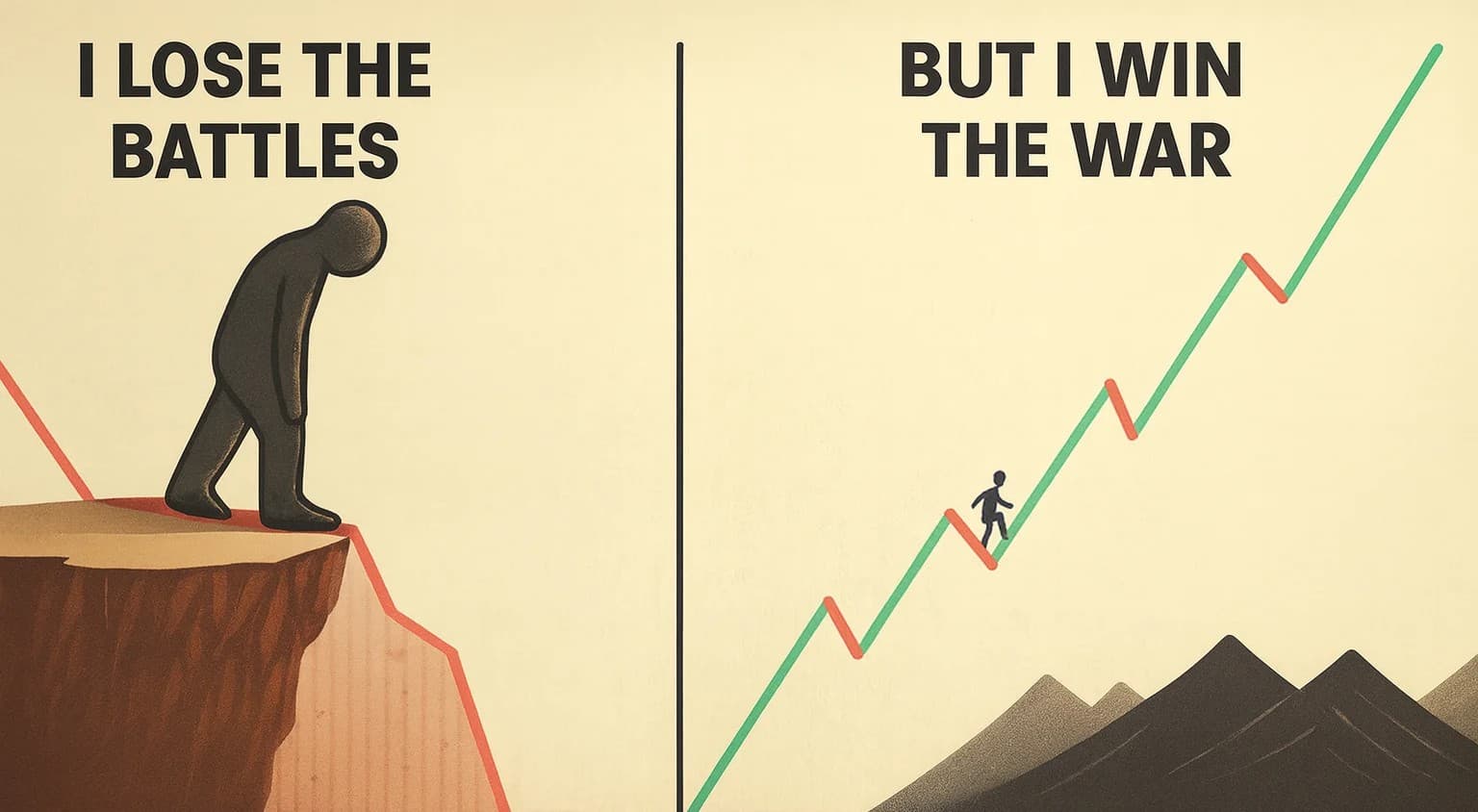
Contrary to what many believe, the 1% are not magicians. They do not possess secret indicators, nor do they have a hotline to central banks. They simply operate differently:
• Master one method.
• Backtest extensively.
• Spend most of their time waiting, not trading.
• Position size based on statistical risk, not feelings.
• Think probabilistically. They accept randomness, noise, false breakouts, and losing streaks.
• Detach emotions from outcomes. What truly matters is the correct execution, not whether a single trade wins or loses.
Their approach is structured and boring — and that is precisely why it works.
Level 1: The System (Where Most Traders Already Fail)
Before dealing with psychology, a trader must first have an actual system. Not a collection of indicators. Not a vibe. A system.
A system consists of:
• clear rules,
• measurable probabilities,
• predictable risk parameters,
• can be repeated consistently.
Without this, a trader cannot know whether a loss is normal variance or the result of randomness. They cannot build money management because they don't know how their method behaves in the long run.
These parameters only come from backtesting and forward testing your own method. Without that data—your win rate, risk-reward, drawdown, losing streaks—you have no baseline. You're flying blind.
This alone eliminates a majority of aspiring traders — they don't have a system, they just have enthusiasm.
Level 2: The Mental Game (Where Even Good Traders Fall Apart)
Trading now becomes a psychological challenge. Human brains were not designed for probabilistic environments; they were designed to avoid danger and seek certainty.
Even if the backtest clearly shows the method can endure 12 consecutive losses, the human mind begins to panic long before that point.
During drawdowns:
Time feels slower. Waiting feels unbearable. Doing nothing feels like torture. Many traders break their rules simply to escape discomfort — not because the setup changed.
The market's real weapon is not volatility — it's your own neurobiology.
Intelligence Doesn’t Guarantee Success
Trading rewards discipline, not brilliance.
Highly intelligent individuals often fail because they:
• overanalyze
• overcomplicate
• seek certainty where none exists
• resist being wrong
• and struggle to accept market's randomness.
Meanwhile, the successful traders may not be extraordinary in IQ — but they are extraordinary in consistency.
The Real Secret 1: Boring Wins
They wait — a lot.
They're extremely picky. If there's momentum that matches their setup, they trade. If there's no momentum, they don't trade at all. Period. They don't go hunting for setups that aren't there.
The old advice like 'don't trade when you're sad or in a bad mood' becomes irrelevant for them. Why? Because they already have a system that just needs to be executed. Their setups are fixed—where to enter, where to exit. There's no room for emotions or other nonsense to influence this.
The Real Secret 2: Act Like a Casino

Casinos have a house edge. It's often small—sometimes just 1-3%—but the house always wins in the long run. Why? Because they execute that edge repeatedly: hundreds of times, thousands of times, millions of times.
The same principle applies to trading. Your house edge is the statistical edge from your method's probabilities. Let's say you have a 50% win rate with a 1:2 risk-reward ratio—that itself is your edge. It doesn't matter if you lose the next three trades. What matters is that over 100, 200, 500 trades, the math plays out in your favor.
But here's the critical part: casinos don't just rely on their edge—they also have an anti-bankruptcy strategy. They ensure they have enough capital to keep running that edge millions of times without going broke, because probability doesn't care about sequence. You could lose 10 times in a row at the start. That's normal variance.
For traders, the casino's 'unlimited money' translates to: large enough capital + small risk per trade = many lives. If you risk 1% per trade, you can survive 50+ consecutive losses before you're out. That's how you stay in the game long enough for your edge to materialize.
Casinos truly embody probabilistic thinking. They don't panic after a player wins big. They don't change the rules mid-game. They just keep running the system, knowing the math will work—eventually.
Be the casino. Not the gambler.
How to Move Toward the 1%
If your goal is to reach consistent profitability, start with the fundamentals:
• Choose one method and commit to it.
• Backtest thoroughly (yes, thoroughly).
• Understand your system's probabilities.
• Follow your rules regardless of emotions.
• Money management based on worst-case scene.
• Evaluate performance over 100 trades, not 5.
If this feels overly structured or unglamorous — good. That means you're on the right track.
Final Thought
The 99% seek thrill, prediction, and instant results. The 1% seek structure, patience, and long-term survival. That difference, though subtle, determines everything.